Where Is Lubricant Demand Growing or Slowing?
Lubricant demand is changing, but not evenly. Differences in industrial activity, vehicle fleets, equipment technology, maintenance practices, and product requirements are influencing how much lubricant is consumed and which products businesses need.
For lubricant buyers, that means broader market trends only tell part of the story. Demand may be growing in one region or industry while slowing in another, and lower overall consumption does not necessarily mean weaker demand for every lubricant.
Demand Is Growing at Different Rates Across Markets
Globally, lubricant demand is being shaped by differences in industrial and economic development.
Lubricant market growth is stronger in parts of Asia-Pacific, particularly markets such as India and China. MarketsandMarkets points to expanding manufacturing, infrastructure, vehicle fleets, and equipment use as factors supporting lubricant demand across the region. As industrial activity expands, so does the need for hydraulic fluids, gear oils, greases, engine oils, and other products used to operate and maintain equipment.
More mature markets, including North America and Europe, are seeing a different pattern. Large vehicle fleets and established industrial sectors continue to support lubricant demand, but other factors can limit volume growth. Mordor Intelligence points to longer drain intervals and changing vehicle technology as factors affecting lubricant consumption in North America, while Fortune Business Insights shows slower growth in Europe compared with developing markets.
These differences show why lubricant demand cannot be defined by a single global trend. How much lubricant is consumed, and which products are needed, depends on the industries, equipment, and technology within each market.
U.S. Lubricant Demand Has Declined Over Time
The United States illustrates how lubricant consumption can change even while the need for lubricants remains significant.
According to the U.S. Energy Information Administration, U.S. product supplied of lubricants totaled approximately 51.6 million barrels in 2004. By 2024, that figure had fallen to 28.8 million barrels, a decline of roughly 44%. Product supplied increased to 32.9 million barrels in 2025, but remained well below levels from two decades earlier.
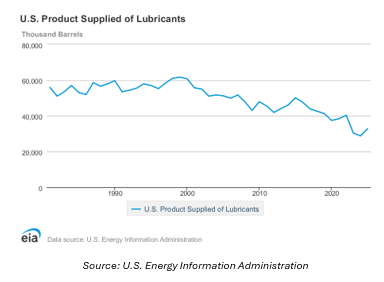
Several structural changes help explain why today’s lubricant market looks different from the market of two decades ago. Engines and industrial equipment have become more efficient, lubricant formulations have improved, and longer drain intervals allow many products to remain in service longer before replacement.
At the same time, the value of the U.S. lubricant market can grow even when physical consumption remains below historical levels. Pricing and greater use of synthetic, specialized, and higher-performance products can contribute to market-value growth without requiring the same increase in gallons consumed.
That distinction is important when evaluating lubricant demand. Market value and physical consumption measure two different things.
Industrial Demand Follows Equipment Activity
Industry activity is another important part of the demand picture.
Manufacturing plants, construction operations, mines, transportation fleets, energy facilities, and other equipment-intensive businesses rely on lubricants to protect hydraulic systems, gears, compressors, bearings, engines, and other components.
When these industries expand, add equipment, or increase utilization, lubricant requirements can grow. This is one reason industrial and infrastructure expansion can support stronger demand in developing markets.
Efficiency can work in the opposite direction. Improved equipment design, preventive maintenance, condition monitoring, and longer lubricant life can extend service intervals and reduce replacement frequency.
For lubricant buyers, equipment activity alone does not determine consumption. Equipment age, operating conditions, utilization, maintenance practices, and manufacturer specifications all influence how much lubricant an operation requires.
Demand Is Becoming More Product-Specific
Changes in lubricant demand are also happening within individual product categories.
Newer equipment and evolving performance requirements can increase demand for certain viscosity grades, synthetic formulations, and specialized industrial lubricants. At the same time, longer-lasting formulations can reduce how frequently those products need to be replaced.
Group III base oils are one example of how demand can become concentrated. These base stocks are widely used in synthetic and lower-viscosity motor oils, making their availability increasingly important as engine-oil specifications have changed.
This helps explain why broader demand figures may not reflect conditions for an individual product. Even when a market is consuming fewer barrels overall, demand can remain strong for particular base stocks, formulations, viscosity grades, or specifications.
What Lubricant Buyers Should Watch
There is no single direction for lubricant demand. Industrial and automotive expansion can support consumption in growing markets, while efficiency improvements and longer service intervals can limit volume growth in more mature markets. At the same time, changing equipment specifications continue to shift demand among lubricant products.
For businesses, the important question is not simply whether lubricant demand is growing or slowing. It is where that demand is moving and whether those changes affect the products that their operations rely on.
Understanding industry activity, equipment requirements, maintenance practices, and product specifications can give buyers a clearer picture of their lubricant needs than overall market figures alone.
As lubricant demand and product requirements continue to change, Mansfield Service Partners can help businesses evaluate their lubricant needs and plan for the products and specifications their operations require.