What’s That: Base Oil Groups
When you hear Group I, Group II, or Group III in the lubricant industry, what does the “group” actually tell you?
Base oils are the building blocks of lubricants. Depending on the formulation, they can make up roughly 75% to 99% of a finished lubricant, with additives providing additional properties needed for a specific application. That means the characteristics of the base oil play an important role in how a finished lubricant is formulated and how it performs.
But not all base oils are the same. The American Petroleum Institute (API) separates base stocks into five groups based on specific physical and chemical characteristics. Understanding those groups provides useful context for why different lubricants are formulated for different equipment, operating temperatures, and performance requirements.
What Is Base Oil?
Base oil is the primary fluid component used to formulate lubricants such as engine oils, hydraulic fluids, gear oils, compressor oils, and greases. Additives are blended with the base oil to provide additional properties such as wear protection, corrosion resistance, detergency, and oxidation control.
Think of the base oil as the foundation of the finished lubricant. Its properties influence important characteristics such as viscosity behavior, oxidation stability, and performance across different operating temperatures. The additive package then builds on that foundation to create a lubricant designed to meet specific performance requirements.
This is why two lubricants intended for different applications can begin with very different base stocks. An industrial lubricant operating under relatively moderate conditions may have different formulation needs than a low-viscosity engine oil expected to perform through cold starts and high operating temperatures.
What Do Base Oil Groups Mean?
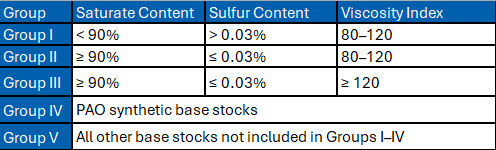
API classifies base stocks into Groups I, II, III, IV, and V based on specific characteristics of the base stock. For Groups I through III, classification is based on saturates, sulfur content, and viscosity index. Groups IV and V are classified based on their chemistry.
Group I base oils are generally produced through solvent refining. Compared with Groups II and III, they have lower saturates and/or higher sulfur levels. While they are less severely refined, they remain useful in applications including industrial lubricants, gear oils, marine lubricants, process oils, and other formulations where their particular properties are beneficial.
Group II base oils are produced using hydrogen processing, which removes or converts more impurities. By API definition, they contain at least 90% saturates and no more than 0.03% sulfur. Group II base stocks are widely used in automotive and heavy-duty engine oils as well as industrial lubricants. Group II base oils are widely used in North America and are commonly found in automotive, heavy-duty, and industrial lubricants. Their properties make them suitable for a broad range of lubricant formulations.
Group III base oils also undergo hydrogen processing, but their defining difference from Group II is a higher viscosity index. API classifies Group III at a viscosity index of 120 or greater. These base stocks are commonly used in lower-viscosity engine oils and industrial lubricants that require strong oxidation stability and performance across a wider temperature range.
Group IV consists of polyalphaolefins, commonly known as PAOs. Unlike Groups I through III, these are manufactured synthetic base stocks. Their oxidation stability and low-temperature properties make them useful in lubricants designed for demanding operating conditions.
Group V is the broad category for base stocks that do not fall within Groups I through IV. It includes materials such as esters, naphthenic base stocks, certain bio-based stocks, and other specialty fluids. Group V materials are often used alongside other base oils to provide specific properties in a finished formulation.
Why Are There Different Groups?
The groups provide a standardized way to distinguish base stocks with different chemical and physical properties. API originally developed the grouping system to support base oil interchange guidelines for engine oils.
For Groups I through III, the differences come down largely to three measurements: saturates, sulfur content, and viscosity index. Understanding what these measurements represent helps explain why the groups can perform differently.
Saturates: Saturates are hydrocarbon molecules with no carbon-to-carbon double bonds. Higher saturates levels generally contribute to greater oxidation stability. Group II and Group III base stocks must contain at least 90% saturates, while Group I contains less than 90% saturates and/or more than 0.03% sulfur.
Sulfur: Sulfur occurs naturally in crude oil and is reduced during refining. Under API’s classification, Group II and Group III base stocks contain no more than 0.03% sulfur.
Viscosity Index: Viscosity index, or VI, describes how much an oil’s viscosity changes as temperature changes. A higher VI generally means the oil’s viscosity changes less across a range of temperatures. Group I and Group II base stocks have a VI between 80 and 119, while Group III begins at 120. Viscosity also plays an important role in how finished lubricants are selected for different applications.
Why Base Oil Groups Matter to Lubricant Buyers
For buyers, base oil groups provide useful context for understanding why products intended for different applications may be formulated differently. A lubricant designed for extreme temperatures, longer service intervals, or demanding engine requirements may require a different base oil foundation than one designed for less severe operating conditions. Those formulation choices can influence oxidation resistance, temperature performance, lubricant life, and cost.
However, buyers should not choose a lubricant based on base oil group alone. The correct product depends on the finished lubricant’s specifications, viscosity grade, equipment manufacturer requirements, operating environment, and application.
Base oil groups can also help buyers understand lubricant supply-chain developments. For example, changes in Group III availability can affect certain full-synthetic and low-viscosity lubricant formulations, with effects that can extend across the broader lubricant supply chain.
Connect with an MSP lubricant expert to learn more about lubricant products and programs for your operation.